
Royalty, the Doctor and Nessie: Glasgow 2026 gets off to a scintillating start
The Glasgow 2026 Commonwealth Games opened in spectacular style on Thursday as The King and The Queen took a cue from the Doctor by emerging into The Hydro from the TARDIS.
While few of the thrilled Glasgow crowd needed a time machine to recall the last visit of the Games to their city, the world’s most famous police box launched a ceremony that will live long in the memory.
The show opened with a curved LED screen - 50 metres wide - beaming the TARDIS' journey around Scotland, including trips to Loch Ness, the Kelpies, and Edinburgh Castle.
With cycling legend Sir Chris Hoy and actor Greg McHugh at the controls - and the Seventh Doctor, Sylvester McCoy, a bemused onlooker - the time machine made a final stop at Balmoral Castle, the home of the Royal Family in the Highlands.
"I'll go - I've met them before," said Hoy with comic aplomb, leaving McHugh behind as he turned towards the castle. The King and The Queen seemingly onboard, the excited gasps of the crowd became an expectant hush as the TARDIS left the giant screen and 'materialised' on stage.
Hoy emerged first, followed a few tantalising seconds later by Queen Camilla and King Charles III, who pretended to peer through the mist as huge cheers rang around The Hydro.
If the TARDIS transported The King and The Queen, then the ceremony delivered on the promise for Glasgow 2026 to innovate at every turn. For the first time in Commonwealth Games history, the athletes entered the arena before the show had unfolded, skirting a giant living garden to a pulsating electro-folk soundtrack.
"I'm immensely proud to lead out so many amazing athletes," Team Wales flagbearer Rosie Eccles, a Birmingham 2022 gold medallist in Women's boxing, said. "It's my birthday today, and they surprised me yesterday with a cake and then asked me if I'd be flagbearer. People don't shock me much, but I was so honoured."
When Team Scotland walked on in a kit of tartan kilts at the end of the Parade, the audience erupted. By then, the uniquely decorated batons of all 74 participating nations and territories had transformed the living garden into a living artwork.
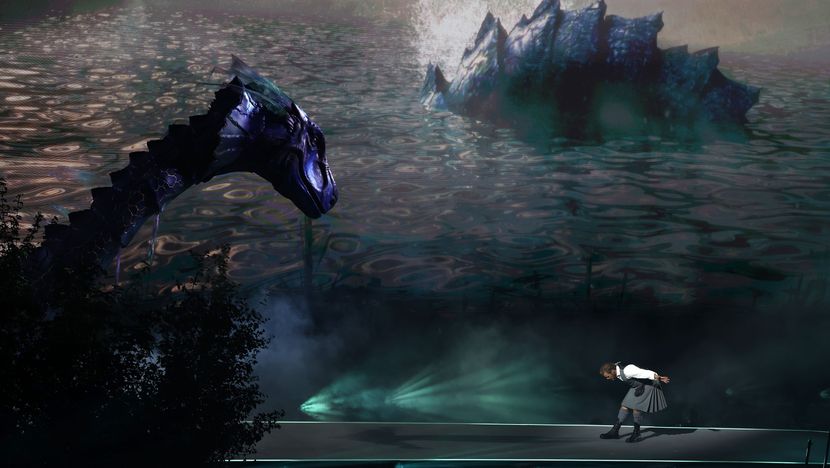
The Loch Ness Monster, 'Nessie' - who else? - was then lured into the arena by actor Sam Heughan, as a band of pipers and drummers played Flower of Scotland - the country’s unofficial anthem.
The ceremony's story extended over one transformative day in the city, as a musical flash mob came together beneath the famous clock at Glasgow Central Station.
Visually stunning tributes were paid to the workers who drove and still drive the city's industries, with dancers memorably 'weaving' a giant fabric on which the city's 'People Make Glasgow' philosophy was emblazoned in Gaelic.
"They say it takes a village to raise a child, well it takes a city to put on an Opening Ceremony and that's exactly what we've done," Louisa Mahon, Glasgow 2026 Chief Marketing and Ceremonies Officer, said.
"We've created a love letter to Glasgow - from our amazing industrial heritage through to the really creative, people-fuelled, passionate city that we are now."
By the end of the main performance, the Glasgow Central clock had become a kaleidoscope as The Hydro went all disco, replete with sparkling unicorns and dancing stars, in celebration of the city's renowned nightlife. Team Scotland led the party from the seats, agreeing with singer Callum Beattie that Yes Sir, I Can Boogie.
"Just seeing people laugh at the bits we hoped they would laugh at, and the interaction of the crowd when they sang along, applauded, got on their feet and were dancing - that was just magical," Mahon said.
Scotland is hosting the Commonwealth Games for the fourth time, with the event returning to Glasgow after an absence of only 12 years. George Black CBE, Chair of Glasgow 2026, heaped praise on the city’s late call to action.
"When the future of these Games was uncertain, Glasgow didn’t ask, 'Can we?'. We asked, 'When do we get started?'," he told The Hydro crowd and an estimated worldwide audience of 750 million people.
"Because that's what we do. We roll up our sleeves and, together, make extraordinary things happen."
After an extraordinary Opening Ceremony, the Glasgow 2026 Commonwealth Games can finally begin.
BBC, Doctor Who (wordmarks, logos and devices), and TARDIS (wordmarks and devices) are trademarks of the British Broadcasting Corporation and are used under licence. BBC logo © BBC 1996. Licensed by BBC Studios Limited
